Choosing China’s top Stackable Storage bins suppliers starts with a practical question: will each bin remain stable, accessible, and durable after repeated handling? In a busy warehouse, the details are physical. A loaded bin shifts on a rack; a lid catches; a label disappears behind another container. Small failures slow picking and create avoidable replacement costs. Not all bins fit.
MHI’s 2024 Annual Industry Report found that 55% of surveyed supply-chain professionals planned to increase investment in supply-chain innovation. That figure is not a forecast for storage bins specifically, but it signals why buyers increasingly assess equipment as part of a wider operational system. MHI CEO John Paxton has emphasized the importance of innovation in responding to changing supply-chain demands; this is a paraphrase of his broader position, not a direct quotation about bins. For buyers, the lesson is useful: compare more than unit price. Check dimensions, load capacity, material consistency, nesting and stacking performance, customization, and sample quality. Ask how tolerances are controlled across production batches.
Supplier claims deserve testing. A sample that stacks neatly on an empty floor may behave differently when fully loaded or moved repeatedly. I would want to see that test. This guide examines Chinese suppliers through product range, manufacturing capability, quality evidence, communication, and export experience. No single ranking fits every warehouse. The right choice depends on the goods, handling method, and available space—and that judgment can be less tidy than a supplier’s catalog suggests.
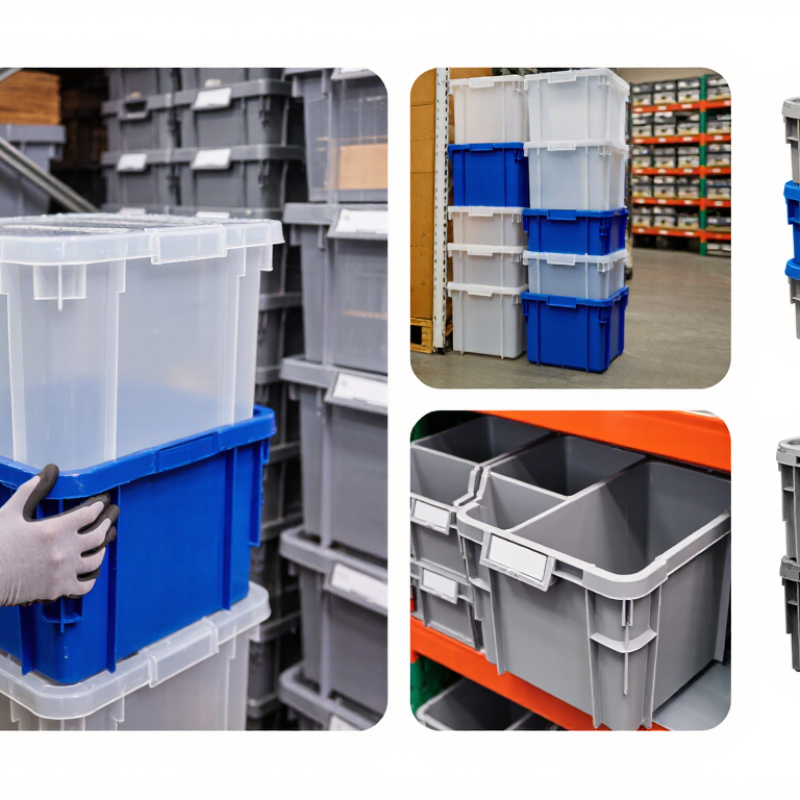
Stackable storage bins are rigid containers designed to sit securely above one another. Their rims, corners, or molded feet help transfer weight downward instead of pressing on the items inside. This creates vertical storage on shelving, carts, or warehouse floors. Small parts can be separated by type, while labels on the front make identification easier.
That matters. Stackable bins differ from nesting bins, which fit inside each other when empty. Some designs do both, but their stacking stability still depends on matching sizes and shapes.
In practice, workers place heavier bins at the bottom and keep the stack within its stated load limit. A level floor helps; so does checking that each bin is fully seated. A tilted stack can shift when a worker pulls out a container. The bin’s material, wall thickness, handles, and lid also affect its suitability for repeated handling.
MHI’s 2024 Annual Industry Report, produced with Deloitte, found that 55% of surveyed supply-chain leaders planned to increase technology investment. That figure concerns supply-chain technology, not bins specifically, but it reflects growing attention to efficient warehouse operations. For buyers comparing suppliers in China, sample testing with actual products and stacking conditions is more useful than relying on dimensions alone. Even good specifications can miss a real-world mismatch.
China Top Stackable Storage Bins Suppliers?
Common Bin Types, Materials, and Industrial Uses
Stackable storage bins come in several forms, each suited to a different handling task. Solid-wall bins protect small parts from dust, while ventilated designs allow airflow around produce or damp components. Attached-lid containers help keep contents together during transport. Picking bins, with open fronts, give workers quick access on assembly lines. Small details matter.
Most industrial bins use polypropylene or high-density polyethylene. Polypropylene is relatively light and often handles repeated indoor use well. HDPE can offer useful impact resistance, especially in cooler work areas. Some suppliers also offer recycled-content options, but performance depends on the blend and manufacturing controls. Ask for material specifications and test samples; a catalog photo cannot show how a bin behaves under load.
Factories use bins for fasteners, molded components, tools, and work-in-progress parts. Warehouses use them to organize picking shelves and reduce loose-item handling. Food and agriculture operations may choose washable, ventilated bins where airflow and cleaning are important. Match dimensions to shelving, conveyors, and pallet patterns before ordering. Check load ratings, stacking stability, and temperature limits with the supplier. A slightly flexible bin may be fine for hand carrying, yet troublesome in a tall stack. There is no perfect type for every workflow.
China’s stackable storage bin suppliers differ less by catalog photos than by how they control fit, consistency, and production changes. Some focus on household bins, while others make heavier-duty containers for workshops or warehouses. Ask for internal dimensions, wall thickness, and loaded stacking limits, not just outside measurements. A bin that nests neatly may not stack securely when full. Small detail, big difference.
Material choices vary too. Polypropylene bins can be light and washable, but resin grade and molding control affect stiffness and odor. Request a current sample and check its rim, base, and corners by hand. Then compare several pieces from one batch. A polished sample alone proves little. Some factories manage mold design and testing in-house; others use outside partners, which can affect revisions and lead times. Neither setup is automatically better, but responsibility for defects should be clear.
Communication and quality checks distinguish suppliers as much as machinery does. A reliable partner confirms drawings, color references, carton packing, and inspection criteria before production. Ask how they record dimensions and handle a failed inspection. The answer should include practical steps, not only promises. Packaging matters as well: nested bins save freight space, yet thin cartons may arrive crushed after a long journey. I would still allow time for a pilot order; even careful specifications can miss something.
| Supplier Type | Typical Product Strength | Customization Approach | Best Fit For | Points to Verify |
|---|---|---|---|---|
| Injection-molding manufacturer | Rigid plastic bins made in repeatable sizes; commonly available with stacking rims, nesting features, or optional lids. | May offer color, dimensions, material, and tooling changes. New designs generally require mold development and validation. | Buyers seeking consistent production runs or a purpose-designed bin. | Mold ownership and costs, resin specification, sample approval, dimensional tolerances, and production capacity. |
| Catalog-focused manufacturer | Established bin designs and standard sizes intended for storage, retail, workshop, or household use. | Usually centers on available options such as color, packaging, labels, and compatible lids rather than major structural redesign. | Buyers who want to evaluate existing products and avoid commissioning a new mold. | Exact internal and external dimensions, load guidance, stacking compatibility, and whether listed options are in current production. |
| Warehouse and logistics-bin specialist | Bins designed around handling and storage workflows; some models include reinforced bases, label areas, or footprints suited to shelving and material-handling systems. | Can focus on dimensions, handling features, and compatibility with the buyer’s storage layout. | Commercial users organizing parts, picking operations, or warehouse inventory. | Compatibility with shelving or conveyors, stated load conditions, stacking stability, and performance under repeated handling. |
| Retail and household storage supplier | Consumer-oriented bins that may prioritize appearance, easy handling, coordinated sizes, and optional lids. | Often supports retail packaging, assortment planning, color choices, and product presentation. | Retailers, importers, and distributors building a household-storage range. | Packaging dimensions, carton quantity, lid fit, surface finish, and any destination-market labeling requirements. |
| Trading or export-focused supplier | May source multiple bin styles or coordinate products from more than one factory, offering buyers a broader range through one contact. | Can coordinate packaging, product selection, and export documentation; technical changes depend on the actual producer. | Buyers consolidating varied products or seeking support with export coordination. | Factory identity, production-site audits, sample traceability, quality responsibility, and who handles corrective actions. |
| Custom product developer | Works toward a buyer-defined design, such as a particular footprint, stack pattern, divider layout, or handling feature. | Typically involves design review, prototypes, tooling discussions, and sample approval before mass production. | Projects where standard catalog bins do not meet specific space or workflow requirements. | Design-file control, tooling terms, prototype criteria, change approval, and production quality checks. |
Note: These are general supplier categories, not rankings of individual companies. Product capabilities and commercial terms vary by factory and should be confirmed with samples, specifications, and written quotations.
China Top Stackable Storage Bins Suppliers?
How to Evaluate Suppliers for Quality and Capacity
When comparing suppliers, ask for clear specifications rather than relying on product photos. Check bin dimensions, resin type, wall thickness, and stated load limits. A sample should be measured and tested with the intended contents. Small details matter. Look for even walls, smooth edges, and lids that stay aligned when bins are stacked. Request test records for repeated stacking and loaded storage, not just a single demonstration. I would not treat a polished sample as proof of consistent mass production; that assumption is easy to make and hard to correct later.
Capacity deserves the same scrutiny as product quality. Ask how many units the factory can produce monthly, and whether that figure applies to your exact size and color. Confirm the minimum order, sample schedule, production lead time, and peak-season availability in writing. Ask how defects are recorded and what happens when inspection results fall outside agreed tolerances. A factory visit or live video walkthrough can help verify equipment, work-in-progress, and packing methods. Ask for proof. Then compare answers across suppliers, since a confident estimate is not the same as a dependable production plan.
Suggested assessment weighting for comparing suppliers. These weights are a practical evaluation framework, not measured market rankings.
Prioritize quality and production capacity. Verify quality with material specifications, sample inspections, and documented quality controls; assess capacity using verified output, equipment, and delivery records. Also check product range, customization capability, lead times, and relevant compliance documents.
When comparing China-based stackable storage bin suppliers, verify the factory behind the quotation, not just the trading address. The OECD’s Global Plastics Outlook reports that global plastics production reached 460 million tonnes in 2019, twice its 2000 level. That scale makes material traceability worth checking. Ask for resin grade, recycled-content declarations, wall-thickness tolerances, and production-lot records. Compare these with a pre-production sample. Paper is not proof. Request a live video tour of molding, trimming, and packing. Confirm the site matches the business license and audit documents.
Next, turn supplier claims into repeatable tests. Measure each bin’s external dimensions and wall thickness, then test nesting, stacking, and loaded stability on a level floor. Record the load, test duration, and any visible deformation. I would still treat a sample as a starting point, not a guarantee. The World Bank’s 2023 Logistics Performance Index ranked China 19th among 139 economies. That national result cannot predict one factory’s dispatch reliability. Ask for recent production timelines, carton specifications, and an agreed pre-shipment inspection plan. Check whether the tested sample, bulk-production material, and packing method match. Small differences matter.
Ask for dimensions, resin grade, wall thickness, and load limits. Request written tolerances, too. Photos can miss small defects.
Measure its walls and edges. Test it with intended contents. Check lid alignment after stacking. A neat sample proves little.
Test nesting, loaded stacking, and stability on a level floor. Record the load, duration, and visible deformation. Keep notes.
Request resin details, recycled-content declarations, and production-lot records. Compare them with the approved sample. Paper is not proof.
Ask for monthly output for your exact size and color. Confirm minimum quantities, lead times, and peak-season availability in writing.
Compare the production site with business and audit documents. Request a live video tour of molding, trimming, and packing. Look closely.
Ask how defects are recorded and what happens when results exceed agreed tolerances. Set a pre-shipment inspection plan before production starts.
No. A country-level ranking cannot forecast one factory’s dispatch reliability. Ask for recent timelines and carton details. I would still be cautious.
This article explains how Stackable Storage bins are designed to fit securely on top of one another, helping businesses use space efficiently while keeping goods organized and accessible. It introduces common bin styles, materials, and industrial applications, from lightweight plastic containers for general storage to sturdier options for demanding warehouse environments. It also outlines how suppliers in China may differ in product range, customization, production capacity, and quality-control practices.
For buyers evaluating potential suppliers, the article highlights practical checks such as reviewing material specifications, inspecting samples, confirming manufacturing capacity, and assessing consistency between production batches. It also describes a step-by-step sourcing process: define requirements, compare suitable suppliers, verify company and factory information, clarify pricing and lead times, and agree on inspection and delivery arrangements. These considerations can help buyers make informed decisions and choose bins that meet their operational needs.

Expandrack